
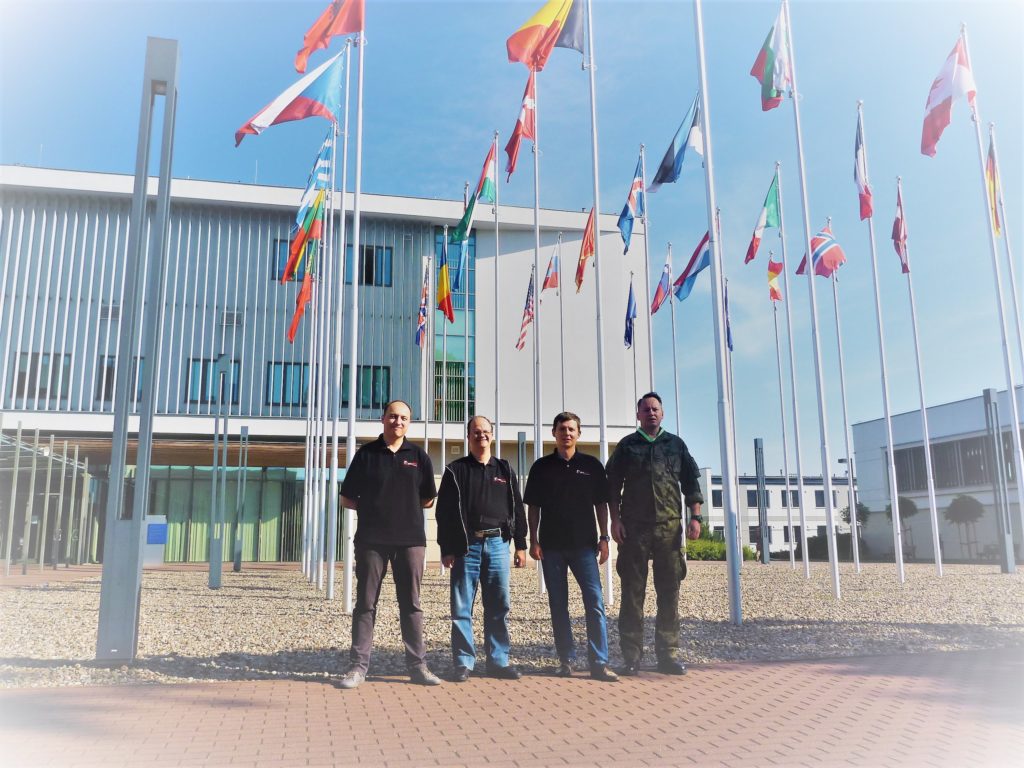
The exercise involved 21 NATO and partner countries. Interoperability was tested—the ability of multinational forces to work together coherently and effectively—before putting it to practical use. The goal was to improve the Alliance’s effectiveness. Around 900 specialists conducted a total of nearly 3,500 technical tests aimed at enhancing interoperability of the Alliance’s forces as well as their operational readiness.
Our company developed the HEKTOR PLATFORM as one integrated solution with three components:
1) Combat Identification Server HEKTOR / CIS HEKTOR
2) Headquarters Management System HEKTOR / HMS HEKTOR
3) Battlefield Management System HEKTOR / BMS HEKTOR
The system’s task was to build situational awareness at various command levels (Battalion—BMS HEKTOR—and Brigade—HMS HEKTOR in the Land Forces), and to verify interoperability with NATO Automated Command and Control Systems (CIS HEKTOR).
In addition, tests were carried out of the IS-1 (System Integrator), which integrated all command-post vehicle elements operating in a Mobile Command Post.
HEKTOR cooperated with C4ISR systems through interfaces enabling two-way information exchange in accordance with standards including: MIP, NFFI, NVG, ADatP-3, ADatP-36, and FFI. The variety of exchanged information and its fusion enabled the creation of the POSO—Combined Operational Situational Picture. This type of capability significantly increases awareness and provides an information advantage on the battlefield.
The system confirmed the ability to exchange information with 22 systems from 12 countries (Poland, Türkiye, Romania, Switzerland, the Czech Republic, Germany, Finland, Italy, the Netherlands, Portugal, the USA, and NATO systems).
CWIX is the largest annual event of this kind, approved by NATO. It fits well with the “Smart Defence” concept and the “Connected Forces Initiative.” Both are realized by connecting and sharing resources, as well as enabling information exchange between NATO member states and partner countries.