
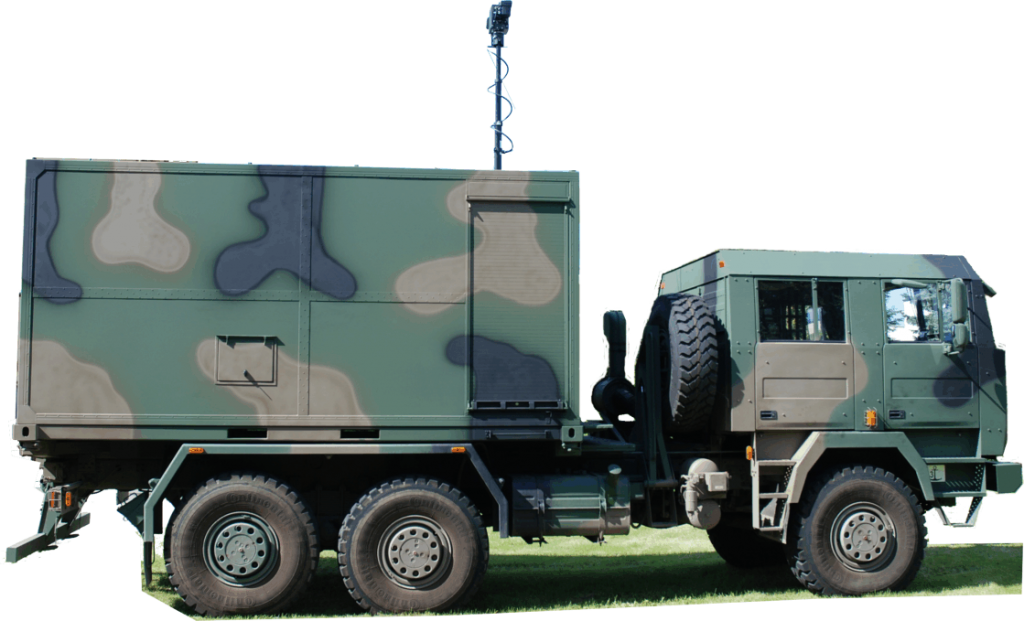
Mobile Teleinformation Node
The Mobile Teleinformatics Node (MWT) is a command post facility oriented towards achieving operational capability in the area of integrated command support systems and battlefield visualisation C4ISR. The MWT constitutes a teleinformatics platform of component-based construction, dedicated to network-centric operation, in accordance with the NNEC (NATO Network Enabled Capability) concept. The task of the MWT is to deliver modern teleinformatics services, including enabling the construction of military networks in IP technology.
The MWT hardware platform ensures cooperation with telecommunication systems operated by the Polish Armed Forces, organising stationary and mobile command posts, and implementation of a BMS-class system, enabling the automation of the command process and the creation of operational situation awareness, including the common operating picture COP. For the construction of the MWT, a 15-foot container was used, electromagnetically sealed (SKW certificate up to and including the SECRET clause) with teleinformatics equipment installed, mounted on a high-load-capacity and high-mobility truck, with a crew cabin (for up to four soldiers).
The MWT enables operation both while stationary and during movement (via HF/VHF radio means). For the construction of the Mobile Teleinformatics Node, primarily available domestic solutions with a high degree of technological advancement were used (including, among others, communication equipment, cryptographic devices, GUU secure voice devices). All devices meet the requirements of applicable standards and norms, in order to enable full cooperation with systems operated in the Polish Armed Forces (e.g. SZAFRAN, STORCZYK, JAŚMIN, IRYS-2000), while simultaneously ensuring interoperability with allied systems.
e.g. SZAFRAN, STORCZYK, JAŚMIN, IRYS-2000
The wired communication subsystem enabling the construction of packet IP networks of LAN/WAN type as well as digital wired networks in the STORCZYK and ISDN system
The VHF and HF radio communication subsystem ensuring full integration of voice telephony services between VHF and HF battlefield radio communication systems and STORCZYK, ISDN, VoIP wireline telephony systems
The internal (on-board) communication subsystem implementing voice and documentary information exchange functions within the crew, providing an output to external systems and implementing wired and wireless remote extension from the facility
An IT hardware platform enabling the installation of a BMS-class battle management system
The threat status notification and signalling subsystem integrating sensors: carbon monoxide detector, smoke detector, chemical contamination detector, radiation contamination detector and laser radiation warning
The object location subsystem based on the GPS system
The object surveillance and observation subsystem providing the possibility of visual control of the situation outside the facility
The authentication, access control and encryption subsystem for voice and digital data exchange, as well as ensuring accountability and audit related to the security of the communication system
The filter-ventilation subsystem
The electrical power supply subsystem
Survival pack
The "MOBILE TELEINFORMATICS NODE" project was carried out by a consortium of companies: Military Communication Works No. 2 S.A. (consortium leader), WB Electronics S.A. and KenBIT Sp. z o. o.